Maths in 3D Modelling
- rishaayakakar09
- Apr 18, 2024
- 2 min read
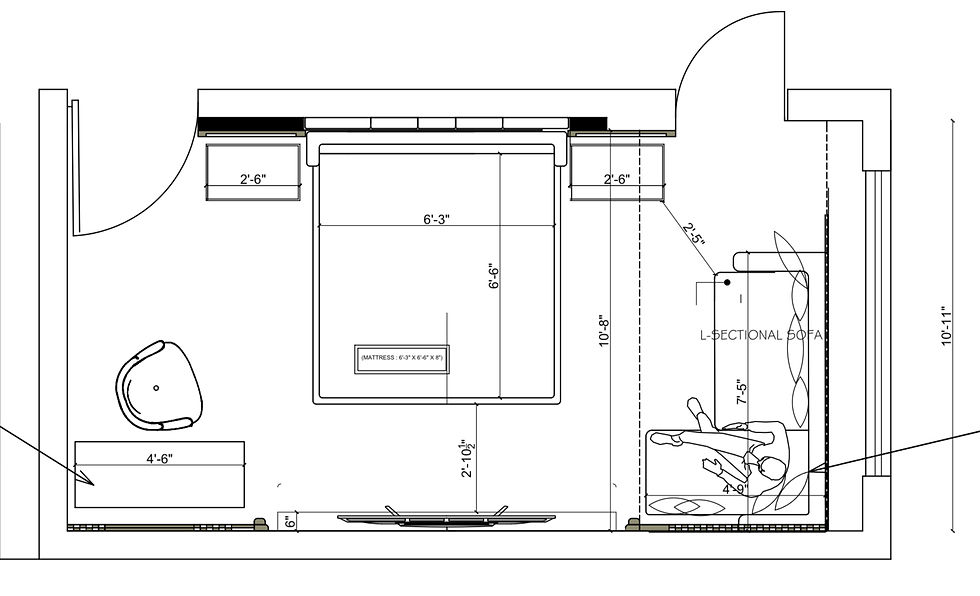
You may be surprised to learn that maths is not only integrated in handcrafted pieces of art but also finds significant usage in artwork created on digital platforms. As designers and architects use different platforms such as AutoCad and SketchUp to create blue-prints or 3D plans, they make an extensive of Mathematics.

Created by: Rishaaya Kakar
Platform used: SketchUp
3D models are composed of relational and geometric information which is generally stored in the form of polygons and vertices. Where, a lot the 3D objects are converted to triangles , to allow easy handling. These objects are thus derived from triangular meshes. This geometric data can be imagined as a set of coordinates or points, having a common origin.
Transformation is an operation that uniformly changes the coordinates of a piece of geometry. Here, the given operation is performed on each vertex and the overall shape is preserved. Therefore, transformation creates a change in the 3D object or coordinate system. The Cartesian Coordinate is thereby instrumental in moving objects in 3D modelling, where each object must be given precise digits to specify their location in the x, y and z axes.Rotation, here, also occurs about axes; the standard way to rotate is by using the left-handed convention. Rotation of an object requires their corresponding matrices to be mentioned to further allow accurate position of objects, within the overall design.
In order to ensure proportionality among the objects, they must be scaled; therefore to make the objects, they have been made bigger or smaller by a factor of k. Applying this scale in all directions, in a uniform manner, they can easily be dilated about the origin. This allows the angles to be preserved. As mentioned earlier, if all the lengths are considered to be a factor of k, then their areas can change by a factor of k^2 , and the volumes by k^3.
What is truly interesting about the usage of maths in 3D modelling, is that its usage is not restricted to the formation of the structure, but rather is even incorporated in giving the Lobby (in this case) a high resolution – photo realistic form, through rendering. This process of rendering is carried out by calculating the paths taken by making the light rays hit different objects from various angles, thereby creating shadows and reflections. These effects give the image an effective look.
In essence, this 3D modelled lobby is clearly a testament to the power of Mathematics in design.


Comments